A Carbon Strategy on Base

Turning DeFi activity into scalable climate impact
Today, Klima, Hydrex, and Azos are introducing the Carbon Strategy, a new primitive that converts onchain capital flows into measurable, permanent climate impact.
This is a demonstration of how we can rewire existing, high-usage systems to scale carbon markets.
Carbon Markets: Good theory. Broken execution?
The theory is sound. Every economic activity carries an environmental cost that traditional markets ignore. Price that externality, and behaviour changes. Compensate or eliminate every tonne of runaway CO₂ and the climate stabilises.
An entire industry grew around this idea. But somewhere between the theory and the execution, it was captured; by consultants, by certification bodies, by voluntary frameworks that evaporate the moment a CFO has a bad quarter.
Carbon accounting sits outside the financial system. It is discretionary. It is expensive. It does not scale.
Participation is often a choice, and often, the choice is not to participate.
Meanwhile, DeFi processes somewhere between $13–20 trillion in annual volume, continuously, automatically, without anyone choosing to opt in. Perpetual DEXs alone cleared $1.5 trillion in 2024 and have accelerated since. Spot DEXs added another $3 to 4 trillion. Lending and other flows, trillions more.
The voluntary carbon market, depending on the source used, is worth somewhere between $500 million and $1.7 billion today. At its 2021 peak it briefly touched $2 billion. It has been declining since.
DeFi annual volume (2025 est.)
Voluntary carbon market
Sources: DefiLlama, KuCoin Research, OKX Ventures, Ecosystem Reports (2024–2025). Carbon market figure represents mid-point of $500M–$1.7B range depending on methodology. DeFi figures represent mid-point estimates.
The contrast between what is happening onchain, and in the carbon markets is stark. And therein lies the opportunity for carbon.
The Carbon Impact Strategy
The Carbon Strategy is an experimental integration of DeFi and carbon markets, built in collaboration with Hydrex, Azos, and Klima.
Hydrex is a MetaDEX that distributes all fees and revenues to its users.
Holders of vote-escrowed Hydrex (veHYDX) vote weekly on liquidity pools, earning a proportional claim on fees and incentives.
Hydrex strategies automate specific outcomes within this system, converting veHYDX rewards into a chosen basket of assets each epoch.
The Carbon Strategy applies this mechanism to environmental assets.
How it works
Step 1 — veHYDX acquisition
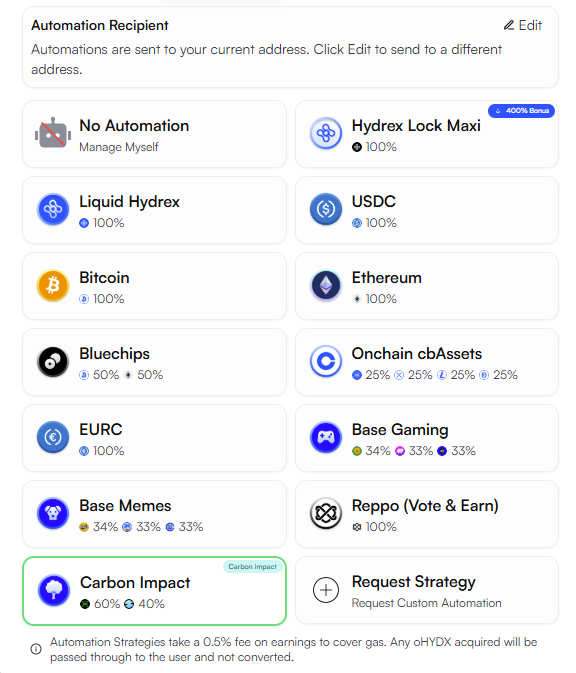
A user with locked Hydrex (veHYDX) allocates it to the Carbon Impact Strategy.
Step 2 — Reward allocation
Each epoch, the strategy automatically collects trading fees and voter incentives from pools across Hydrex from each user and converts them:
- 60% → kVCM
- 40% → AZUSD
Step 3 — Distribution
Of the strategy assets:
- 100% of AZUSD is distributed to users
- 66% of kVCM is distributed to users
- 33% of kVCM is used to permanently retire carbon credits
This produces two simultaneous effects: continuous onchain carbon retirements, and sustained demand for environmental assets on Base, supporting their growth and capacity to scale.
Step 4 — Carbon retirement flow
Retired kVCM is routed through Klima's retirement aggregator, producing verifiable carbon retirements with public on-chain records, attributed to Hydrex.
Proof of impact
All retirements generated by the strategy are tracked onchain and publicly visible. A dedicated impact page will be held on Carbonmark.com showing total carbon retired, the number of retirements, and the types of carbon credits used.
Impact becomes a live, transparent metric. Not an abstraction.
Aligning incentives
The Carbon Strategy works because it aligns the interests of participants within our ecosystem.
Klima and its community is incentivised to acquire and lock more HYDX, direct emissions into the strategy, and maximise retirements: increasing Klima's value to the carbon markets as a legitimate source of retirement demand.
Hydrex is incentivised to scale the strategy and position itself as Base's impact layer, attracting users through differentiated utility: driving HYDX demand, deeper locks, and stronger ecosystem alignment across Base.
Azos provides liquidity infrastructure for regenerative assets on Base. As kVCM strengthens, the value of backing assets inside Azos increases, system risk decreases, and borrowers benefit from improved collateral: enabling loan repayment, collateral expansion, and the growth of Base-native regenerative markets.
What comes next
The strategy goes live on April 1st 2026 at hydrex.fi.
Klima will allocate its veHYDX to the Carbon Strategy within Hydrex, ensuring immediate impact via the strategy.
A new primitive
For decades, environmental economists have argued for one thing above all else: a system that internalises the cost of carbon into economic activity. The papers have been written. The models have been built. The policies have been drafted.
Our approach is different: a small integration. No consultancy fees. No manual intervention. Every trade, every fee, every epoch. Routing a fraction of DeFi's activity into impactful carbon retirements, automatically, at scale.
This is what internalisation looks like.